
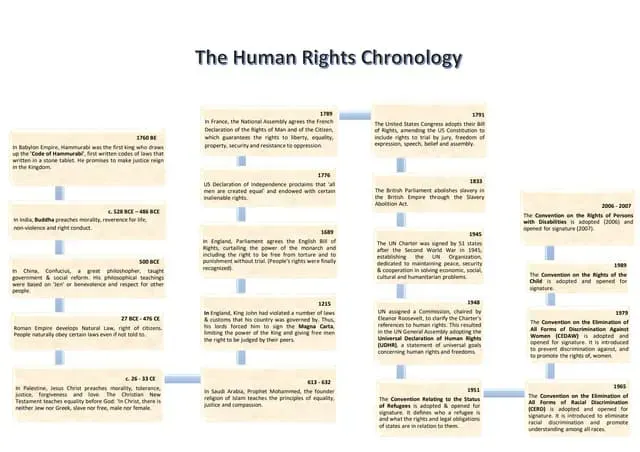
History of the Human Rights Framework is not a single document or event but a long arc of evolving norms, institutions, and practices that shape global justice across generations, regions, and cultures. From the Universal Declaration of Human Rights history to the contemporary framework, this trajectory shows how aspirational ideals became legally binding under international human rights law. The UDHR, adopted in 1948, did not itself create binding law, but it established normative benchmarks that guided national constitutions, treaties, courts, and everyday governance. Its evolution of the human rights framework turned ideals into obligations through instruments like the ICCPR and ICESCR, laying the groundwork for enforcement, monitoring, and accountability across diverse legal systems. Alongside these milestones in human rights, regional mechanisms and ongoing advocacy continue to translate rights into policy choices, court decisions, and everyday protections for people everywhere.
Seen through an alternative frame, this narrative maps the rise of a global rights regime, where norms become laws, institutions, and remedies that communities can rely on. Scholars describe the progression as a normative architecture that moves from aspirational declarations to binding obligations within international law, regional courts, and treaty bodies. In this lens, education, civil society advocacy, and judicial interpretation push protections into daily practice while acknowledging regional variations and cultural nuance. Despite these differences, the shared aspiration remains: dignity, equality, and freedom for all, realized through active participation by citizens, states, and international actors.
History of the Human Rights Framework: From UDHR to Binding Covenants
The Universal Declaration of Human Rights (UDHR), adopted in 1948, is widely described as the cornerstone of the History of the Human Rights Framework, establishing a universal standard of dignity. While the UDHR itself did not create binding obligations, its aspirational language shaped constitutions, domestic laws, and judicial decisions for generations. Understanding the Universal Declaration of Human Rights history helps explain its enduring influence on constitutional design and judicial interpretation around the world.
With the 1966 covenants—the ICCPR and ICESCR—the UDHR history took a decisive turn: aspirational rights were turned into legally binding obligations for states that ratified them. This moment, a core element of the evolution of the human rights framework, anchored civil, political, economic, and social rights in international human rights law and established monitoring and accountability through treaty bodies.
Milestones in Human Rights and the Evolution of International Human Rights Law
Vienna Declaration and Programme of Action (1993) reaffirmed the UDHR’s universality and emphasized indivisibility, interdependence, and universality of rights. This moment stands as one of the milestones in human rights history, reinforcing that rights are universal and must be implemented without discrimination, while calling attention to root causes such as poverty and weak institutions.
Beyond Vienna, further milestones in human rights include the 1984 Convention against Torture, the 2006 Optional Protocols to core treaties, and the expansion of regional systems—the European Court of Human Rights, the Inter-American Commission and Court, and the African Charter on Human and Peoples’ Rights. These developments anchor international human rights law in practice, strengthening monitoring, remedies, and regional protection for civil, political, economic, social, and cultural rights.
Frequently Asked Questions
What is the UDHR and why is it central to the history of the human rights framework and international human rights law?
The Universal Declaration of Human Rights (UDHR), adopted in 1948, anchors the history of the human rights framework by articulating a universal set of rights. While not binding itself, the UDHR established normative benchmarks that guide national constitutions, international treaties, and court decisions, shaping the development of international human rights law. Its aspirational language provided the starting point for later covenants, monitoring mechanisms, and regional instruments, illustrating how rights evolve from ideals to enforceable standards across the globe.
What are the key milestones in human rights that illustrate the evolution of the history of the human rights framework toward binding obligations and regional protections?
A pivotal milestone is the 1966 adoption of the ICCPR and ICESCR, which turned broad rights into legally binding obligations for states within international human rights law. Subsequent developments include the creation of treaty bodies and the Universal Periodic Review, plus regional mechanisms such as the European Court of Human Rights, the Inter-American Court, and the African Charter system, each reinforcing accountability and enforcement. The Vienna Declaration (1993) and related instruments further advanced the evolution of the human rights framework, highlighting universality, indivisibility, and the need for ongoing reforms in a changing world.
| Key Point | Summary | Representative Aspects / Examples |
|---|---|---|
| UDHR (1948) – Foundational Document | Laid the universal rights framework and normative benchmarks guiding constitutions, treaties, and court decisions, though not legally binding itself. | Civil/political rights; economic/social/cultural rights; aspirational language |
| Covenant Era (1966) – ICCPR & ICESCR | Turned rights into legally binding obligations for states; established enforceable standards and monitoring mechanisms. | ICCPR emphasizes liberty, due process; ICESCR emphasizes education, health, work, standard of living |
| Monitoring, Accountability, Treaty Bodies | Treaty bodies, Universal Periodic Review (UPR), special rapporteurs monitor compliance and provide remedies. | Data collection, oversight, advocacy |
| Regional Frameworks | Regional systems reflect regional legal cultures, threats, and political contexts; jurisprudence shapes national laws. | European Court of Human Rights; Inter-American System; African Charter |
| Vienna Declaration and Beyond (1993) | Affirmed indivisibility, interdependence, universality; emphasized implementation and addressing root causes. | Holistic rights approach; ongoing treaty evolution |
| The Digital Age | Digital rights and governance—privacy, expression online, data protection; balancing security and liberties. | Algorithmic accountability; right to be forgotten |
| Challenges and Debates | Universalism vs local contexts; enforcement, sovereignty, resource constraints; bridge rhetoric and reality. | Cultural relativism debates; implementation gaps |
| Civil Society & National Implementation | Civil society, judges, educators translate norms into protections; education and advocacy drive national adoption. | National constitutions referencing UDHR; bottom-up protection |
| Milestones | Key anchors: UDHR (1948), Covenants (1966), Torture Convention (1984), Vienna (1993), Optional Protocols (2006), expanding rights | Women, children, persons with disabilities, climate-displaced rights |
| Road Ahead | Strengthen implementation, improve data, expand participation; adapt to technology while preserving UDHR core. | Institutional reforms; inclusive governance; new instruments |
Summary
History of the Human Rights Framework traces a long arc from the Unified Declaration to the contemporary system, showing how aspirational ideals became binding obligations and guiding national laws and international cooperation. The UDHR anchors the rights project; the 1966 covenants transform ideals into enforceable obligations; treaty bodies, regional frameworks, and special mechanisms provide monitoring and accountability; regional systems diversify pathways to protect civil, political, economic, social, and cultural rights. The Vienna Declaration (1993) reaffirmed universality and indivisibility and highlighted implementation, while the Digital Age introduces new dimensions of privacy and expression online. Ongoing debates about universalism, enforcement, and culture persist, but civil society and education drive national adaptation, ensuring rights protections translate into practice. Looking ahead, stronger national legal systems, better data, inclusive governance, and adaptive instruments will help realize the UDHR’s promises for all people, everywhere.